Category: journalism
New York Post Made A Big Mistake; Mediaite, Others Made It Worse
The New York Post made a big mistake Sunday by publishing a Facebook chat “interview” with an imposter masquerading as the brother of Newtown shooter Adam Lanza. Mediaite made it worse, first hyping the report with zero skepticism, then keeping its story hyping the original NYP report up hours after the tabloid’s update with a family spokesman denying Ryan Lanza gave the interview or set up a tribute page for his brother and slain mother on Facebook.

The Mediaite version was live hours after the New York Post updated its story with the spokesman’s claim of a hoax.
When the site finally updated, it left a bad headline in place — only striking through Lanza’s name and adding a note at the top repeating the NYP statement. Someone apparently deleted an earlier tweet touting the initial Mediaite version — a tweet I did in reply is left but the original no longer shows up. Unlike the NYP, Mediaite didn’t tweet an update.

Mediaite wasn’t alone in running with a spurious story that never should have been published. Gawker replaced its post with a brief update but left up the comments about it — including those chiding it for believing the NYP at all. Yahoo News blew it by posting the story, then putting the “update” at the bottom. Gothamist did a write through with the update but the url still heralds the mistake of playing follow the leader with the Post. Huffington Post is the only one I’ve seen so far to run an editor’s note explaining the situation. No apology.

Admitting to a hoax without apologizing.
For all of its faults, starting with ignoring a field of red Facebook flags, when the Post was notified, the headline was changed and the update was tweeted. It would have been even better to run a formal correction and/or admission of error. Instead, the tabloid left a lot of the details for the Washington Post to fill in.
As for the lemmings that followed the NYP thinking that attribition to another media outlet offers some kind of pass or absolution in case a story is wrong, it doesn’t.
Reporter Kidnapped In Iraq; Translator Killed
In news suppressed by major U.S. news outlets until now, freelance reporter Jill Carroll has been kidnapped while on assignment in Iraq for the Christian Science Monitor. Her Iraqi interpreter, one of many who risk their lives as much as any journalist, was killed in the Saturday morning kidnapping. According to Editor & Publisher, the news was withheld initially at the Monitor’s request and released after it appeared in dozens of news outlets outside the U.S. I’ll deal with the futility of withholding news in the Internet Age another time. News stories: CSM | E&P. (Links via Romenesko.)
Now I join the Monitor and others in urging the release of this journalist and the protection of her colleagues and the people who make their work possible. Without them we outside Iraq have no hope of ever understanding what is going on inside a war zone that is also a home to millions. My thoughts and prayers are with Jill and those who know and love her.
From the Monitor’s statement:
"Jill’s ability to help others understand the issues
facing all groups in Iraq has been invaluable. We are urgently seeking
information about Ms. Carroll and are pursuing every avenue to secure
her release." — Richard Bergenheim, Editor
It would be nice if someone removed the "give a gift subscription" ad from the bottom of the statement. I don’t think anyone is trying to benefit; it just doesn’t look good.
(Disclosure: I’ve freelanced for CSM since 2004 under far less dangerous circumstances.)
Euphoria, Then Sadness
One of those nights when the name of this blog is reflected in the news. A few hours ago, I came back to my Las Vegas hotel room to drop off some things and caught the welcome news on CNN that 12 miners missing after a West Virginia mine explosion had survived. Back from dinner and working away with CNN in the background, I was half-listening to Anderson Cooper live in West Virginia — and noting that CNN was truly live, not Memorex — when a woman and children rushed up the camera blurting out that it had all been a mistake.One man survived; the rest were confirmed dead.
It was a startling moment in so many ways. With no way of confirming at that moment what he — and we — were being told, the story continued nearly unchecked. In a way, it was a replay of the way the news of survival was delivered hours earlier — a variation of the telegraph game run horribly amuck. This time, the news was right — one man survived and had been rushed to the hospital; the rest, in a horrible reversal, would not be coming home.
As I type, angry family members are being interviewed by Miles O’Brien. For now, the anger is aimed at the company, particularly the top exec. Earlier, during a press conference witjh Gov. Joe Manchini, reporters tried to figure out how much blame he should bear — some used a comment he made as a confirmation of the survival. But it wasn’t the governor who reported the survival story.
At some point, the media covering this story needs to look inward and consider the contribution journalists made to the spread of inaccurate reports. We all make mistakes (I made one Tueaday that’s still driving me crazy); most of us, if not all, likely have repeated inaccurate information because it came from a reliable source. But we can — and should — take responsibility for what we report and how we report it.
Addendum: I’m not suggesting this coverage was based
on reliable sources; the sourcing and decision-making is unclear at
this point. The AP’s reporting certainly contributed to some of the coverage but that doesn’t explain why so many journalists at what had become a major media event went with what appears to be hearsay instead of waiting for official confirmation. The live coverage of the euphoric scene had its own power. What would I or any of you have done in their place? The temptation to believe in miracles can’t be underestimated. Neither can group-think. I hope I would have been skeptical.
Sloppy journalism
Memo to CNN and any other news outlet or journalist tempted to repeat "details" without checking:
A reference this morning to Supreme Court nominee Harriet Miers’ volunteer work for a group called Exodus Ministries left some people — including journalists — leaping to conclusions and assumptions. A few minutes ago, CNN anchor Kyra Phillips said she heard on NPR and from "a number of people" that Miers was involved with the Exodus Ministries that says gay people can go straight with the help of Jesus. Even when her guest, constitutional law expert David Oblon, suggested she was talking about the wrong group — that Miers volunteered for a similarly named group in Dallas helping ex-convicts — she insisted on talking about how this might affect rulings on gay issues and Oblon actually started to talk about how "if it’s true that she was supporting the ex-gays, well, that tells you a little bit about her."
Actually, the whole thing tells me a lot more about the people making these statements. If you don’t know, don’t speculate. Find the answer. Don’t assume something you hear is gospel. Check it out. In this case, while they were babbling, I managed to find the right web site for Orlando-based Exodus International, where a press release clearly states:
"Harriet Miers, nominee
for the U.S. Supreme Court, served on the board of directors of Exodus Ministry in East Dallas, an organization that assists ex-offenders in finding jobs and places to live. The organization is in not
related to Exodus International, the world’s largest educational and informational outreach dealing with homosexuality." (The emphasis is theirs, not mine.)
This is not rocket science. I’ve been part of covering the nomination of a justice — Clarence Thomas worked in Missouri and had strong ties here, which made me part of the Time team looking into his background. If we’d gone around mentioning every piece of information we heard or came across without checking it a lot of misinformation would have been in the public record.
The ability to send words around the globe instantly via digits or satellite doesn’t mean you have to cut corners. If anything, it means you should be even more careful.
Coda: Find out more about the Exodus Ministries where Miers did volunteer.
CNN’s Sit Room: Deja Vu All Over Again
Reading about the new CNN Situation Room and the other interactive efforts underway, I had the strangest feeling we’d stood and talked like this before. (Apologies to Rogers & Hart.) We had — the CNN show was called TalkBack Live and it broke the ground the others stand on today. And yet it’s as if the show never happened. I’ve posted the full article I wrote about TBL seven years ago in extended comments; here are some excerpts.
On any given day, participants can join a live audience, enter an on-line
chat room, send e-mail, phone in or fax in. By late August, "TalkBack Live‘s" newest access point — video conferencing — should be out of testing and ready to go. And computer users with a fairly fast connection, a decent video card and the right software don’t have to turn on a TV to watch the show via Webcast. …When "TalkBack Live" debuted on Aug. 22, 1994, the reviews were not all kind. Some were downright dismissive of the techno-gimmickry and the addition of yet another talk show. One reviewer described it as CNN’s "’Larry King Live‘ crossed with ‘Donahue’ with just a hint of talk radio." …
It may be hard to imagine, but the show began before the Web was a household word. Back then CNN’s major on-line presence was through CompuServe, where "TalkBack Live" hosted a forum. E-mail, faxes and phone calls were all part of the mix. The show even tried video conferencing, but the technology was too slow to be of real use. …
I’m not suggesting the Sit Room is a TBL remake or that it isn’t worth attention in its own right. But it didn’t spring from Zeus fully formed, either, and a lot of what’s being tried now isn’t new.
([“mb”,”
\r\nThat way there are no commercials, though CNN does run a promo every time you
\r\n"tune in."
\r\n
\r\nSoon, viewers may even have a direct say in the topics to be discussed on
\r\nthat day\’s show.
\r\n
\r\nWhen "TalkBack Live" debuted on Aug. 22, 1994, the reviews were not all kind.
\r\nSome were downright dismissive of the techno-gimmickry and the addition of yet
\r\nanother talk show. One reviewer described it as CNN\’s " \’Larry King Live\’
\r\ncrossed with \’Donahue\’ with just a hint of talk radio."
\r\n
\r\nToday, however, the concept doesn\’t seem so far-fetched, says Teya Ryan, vice
\r\npresident of program development for CNN Productions and the creator of
\r\n"TalkBack Live."
\r\n
\r\n"A lot of it came out of the \’92 campaign, when you started to see the
\r\ncandidates going around the media and to the public trying to create a direct
\r\nline. . . . It seemed the public was really responding," she says. "They wanted
\r\nmore direct access to people that influence their lives, and those people could
\r\nbe the president, members of Congress, the head of a corporation, anyone whom
\r\nthe general public generally doesn\’t have direct access to."
\r\n
\r\nCNN, she thought, was in a unique position to make this happen as a network
\r\nthat has room "to go beyond the experts and create a direct link between the
\r\npublic and the people who have power in the country."
\r\n
\r\nA live audience in the atrium of CNN Center in Atlanta was the core of the
\r\nidea, but Ryan thought the show could do more. "People were beginning to
\r\ncommunicate in ways that were really different. If I was going to open this up I
\r\nthought we should do it in a way that acknowledged that."
\r\n
\r\nAnd, she added, "I felt that we shouldn\’t close the doors to anyone. If you
\r\ncouldn\’t come to Atlanta but could send in a fax, you should get on the show."”,1]
);
//–>
Journalist Fakher Haider Murdered in Iraq
How many of us risk our lives to cover the news? Some our colleagues covering Hurricance Katrina have been in harm’s way but few of us face the day in, day out danger confronted by reporters in war zones. Today’s news is the latest in a sad series: Fakher Haider, 38, husband, father of three and an Iraqi journalist and photographer working for the New York Times, was abducted at gunpoint and found dead hours later, hands bound, bag over his head.
More On Gabe Rivera’s Memeorandum
Britt Blaser wonders "Could someone ask them to light up katrina.memeorandum?" I approached Gabe about doing just that nearly two weeks ago. We went back and forth about the idea; his chief concern was whether a hurried effort would add enough to the conversation about Katrina. (via Scripting News) It took Gabe months to get tech.meme to beta and then live; it may all be automated but getting it that way required an intense amount of work on his part. Ideally — from my perspective — he’d be able to set up something in response to breaking news but it might require a different approach to sourcing. Now that tech.mem is live maybe the idea of a dedicated Katrina page can be revisited.
One other point: As good as tech.meme and its predecessor are, they aren’t exhaustive. In order to be included in the conversation, the site either must be part of the primary list or, I believe, linked to by someone in that universe.
Gabe, if I’m off target, I feel confidant that you will set me straight.
Related: Automated Tech News Site Goes Live
Automated Tech News Site Goes Live
A nifty new web service went live tonight — Gabe Rivera’s tech.memeorandum.com. I’ve been testing Gabe’s handiwork since late June when he sent me a note suggesting "you might be interested in monitoring my still-in-development Tech news site. By "interested", I mean it actually might assist you in your work!"
He was right. I quickly became addicted to checking the site, often multiple times a day, to see what kind of buzz it was picking up in the tech world. The pages are built automatically, pulling from mentions across the tech blogosphere and news universe. Just posting may not be enough to make the page, as I quickly found out, but posts bubble up as links multiply. One link from a site weighted heavily in Gabe’s equation can push a post into view.
Gabe explains his goals here so I won’t go into detail. The highlights: Recognize the web as an editor; rapidly uncover new sources; relate the conversation. I like watching the conversation evolve as a story moves around the web, often in ways I would not have imagined.
He started the process with a politics/current events page that crosses political boundaries and cuts through some of the partisan kludge. I’ve given him a couple of ideas for future memeorandums — personally, I’d like one on journalism ethics — but these aren’t easy to build. I’m looking forward to whatever he puts his energy to next. Thanks for the head start on this one, Gabe.
Update: Just saw Robert Scoble’s rave review. He goes into enough detail for both of us.
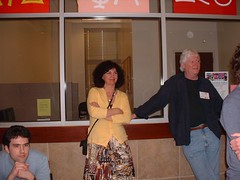
Coda: That’s Gabe on the left — a picture he thought he wound up in by accident but I took very deliberately at the end of BlogNashville.
No Women Voters For This Year’s BCS Poll
Every so often, something pops up on my radar to remind me how much further women have to go when it comes to sports. The latest example comes from Joanne C. Gerstner, president of AWSM (Association of Women in Sports Media): the 114-member panel voting on the weekly ranking for the BCS does not include a single woman. AWSM quickly expressed its concerns to the BCS and to Harris, which is administering the poll. According to the BCS, the 300-person pool — from which Harris randomly selected the participants — included "a few women." The nominees from each conference were supposed to be former coaches, players, administrators and media.
No recourse for this year but AWSM has been asked to contribute potential panelists for next year; it’s not a guarantee of inclusion but at least the pool will start off with a higher potential to include some women panalists. (That’s assuming the controversial BCS poll doesn’t implode before then.) As Joanne wrote to members: "We need to get involved, so there are no excuses for
future panels. We demand women be represented."
Women certainly are represented in other ways when it comes to college football — as journalists, administrators, cheerleaders, season ticket holders, merchandise buyers, just to name a few. We shouldn’t have to demand that women be represented in the BCS or similar endeavors but we still aren’t anywhere close to a time when that might be the case.
The same newsletter included a new PayPal option for renewing dues. Done.
Coda: It was 25 years ago this summer when I had the chance to shadow Atlanta Journal baseball writer Tim Tucker. My first trip into the Braves clubhouse was memorable, to put it mildy. Three years earlier, SI’s Melissa Ludtke bravely pushed back when Bowie Kuhn excercised his power as commissioner of baseball and told her she couldn’t cover the World Series alongside her male colleagues; the locker room was off limits. She went to court backed by Time Inc. and won in time for the 1978 World Series. In response, Braves owner Ted Turner bought his players bathrobes to wear whenever women were announced. The problem the night I went in: someone decided it would be more fun not to make the announcement. We all survived.
USA Today Trusts — But Doesn’t Verify
USA Today relearned a tough lesson this week when large chunks of a feature story published Aug. 8 about a businessman turned out not to be true. A quick search or two might have saved the paper from a great deal of embarrassment — not that search engines are infallible but they are a good place to start, especially when the details being offered include being a Boston Bruins’ draft pick, a Harvard hockey player and a number of other items likely to be logged in multiple places. Instant red flag if the name doesn’t turn up anything close. Instead, the inconsistencies came to light after publication; the paper published a follow-up today including an apology from a publicist but no apology of its own.
Steve Outing posted a correction today — and a mea culpa — for a post he made on Wikipedia based on what turns out to be a flawed Reuters’ article based on a German-language newspaper report based on an interview in English with Wikipedia founder Jimmy Wales. He wasn’t the only one to pick up the story that — erroneously, according to Wales — said a change in policy was on the way that would freeze some articles. (Though, as far as I know, he’s the only one to correct it.) I saw the same story and put it aside until I could find out more but I just as easily could have popped it online without doing any legwork. After all, it was an interesting report from a trusted source; I post items on that basis all the time.
It’s almost tangential but I might as well bring it up before someone else does. Both of these cases are about mainstream media making mistakes. I can hear the comments now — I’ve seen enough of them — how can they complain about bloggers getting it wrong when they make mistakes like this? I’ll go back to kindergarten for this one: two wrongs don’t make a right. Sloppiness or mistakes in one category don’t excuse similar behavior in another. The difference here is that while it would be morally and ethically nice if everyone checked out everything before they post it — and, in most cases, a quick check or a moment’s thought would be deterrent enough — it’s the journalist’s job to do it. Even so, anyone who abuses the reader/listener/user/viewer’s trust will lose it no matter what they call themselves.
How far do we go in checking something out? How much do we challenge? How do we use information that should be shared but may not be provable? How do we decide when not to include information we know to be true? We hold a story back if it doesn’t ring right. We make judgment calls. We attribute. Inevitably, we have to take some things on face value. We correct our mistakes. And we try very hard not to make the same mistake twice.
Coda: I was about to post this when I did another search and found this story by Mike Eidelbes at InsideCollegeHockey.com, who saw the original USA Today piece and then started seeing red flags as he went from resource to resource without turning up Larry Twombly. He contacted USA Today reporter Stephanie Armour and was told they’d found discrepancies.
 Trust But Verify