One side effect of the NFL’s punt on Ray Rice: the reaction to the reaction sent a torrent of nastiness at women in sports media who spoke out, most notably Sam Ponder and Michelle Beadle. Unfortunately, that’s not new behavior, merely a new reason, but it was enough to grab the attention of some men who previously shrugged it off. The same afternoon that ESPN announced that, despite his apology, Stephen A. Smith would be off the air for a week after suggesting domestic violence is the victim’s responsibility, his colleague Bomani Jonestook to Twitter to explain why enough was enough for him:
After days of boxing myself into usual-suspect coverage on TV, in print and online, I decided to broaden my view of the events in Gaza and Israel by creating a Twitter list with only two criteria: job description and geography. The list of 75+ journalists on the ground includes a few based in the Middle East and some who are parachuting in on assignment but it is on-the-scene reporting via Twitter, most of it in real time.
One byproduct: it includes their RTs and source sharing so takes the view even wider.
One caveat: not all journalists on this list adhere to the same definitions and guidelines for covering news. Many are personally involved; some report only one side or lean more toward accepting one side’s official view. I’ve left off a few who swing so far to advocacy that any sense of reporting is missing but I’ve tried not to let my own view of journalism or my personal background get in the way.
The result is a timeline that does exactly what I wanted: takes me outside the bubble. Who’s missing? Suggestions welcome.
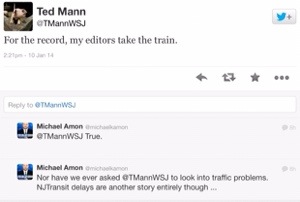
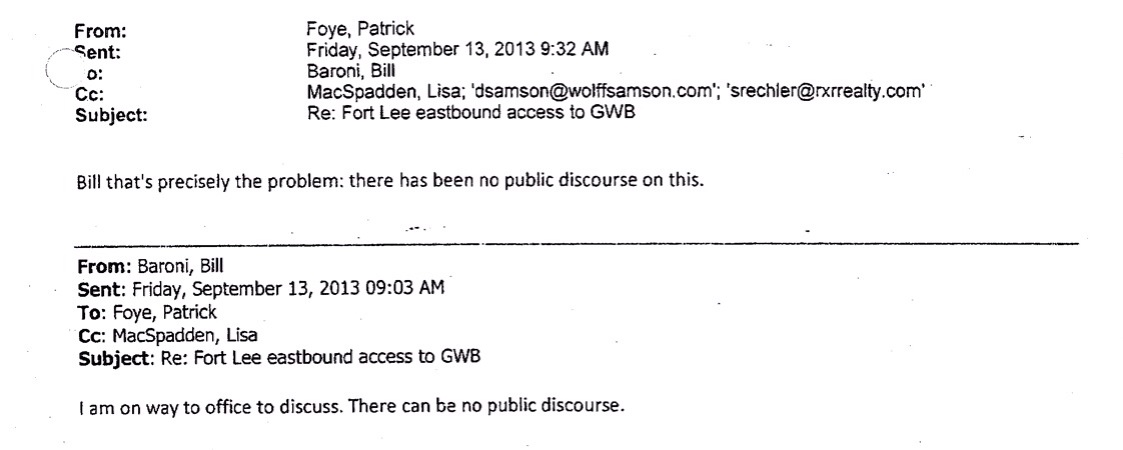
The response of a reporter following up on a tip that his editor spent too much time in traffic? No, this reply came from David Wildstein, the Chris Christie Port Authority appointee who took the fifth when called before a committee investigating the politics behind the September closure of the George Washington Bridge. That same New Jersey Assembly committee released a cache of documents on the case Friday afternoon, including gems like this from Wildstein’s correspondence:
By the way, Mann and his editors say they don’t know where that claim about his request being based on editors stuck in traffic came from:
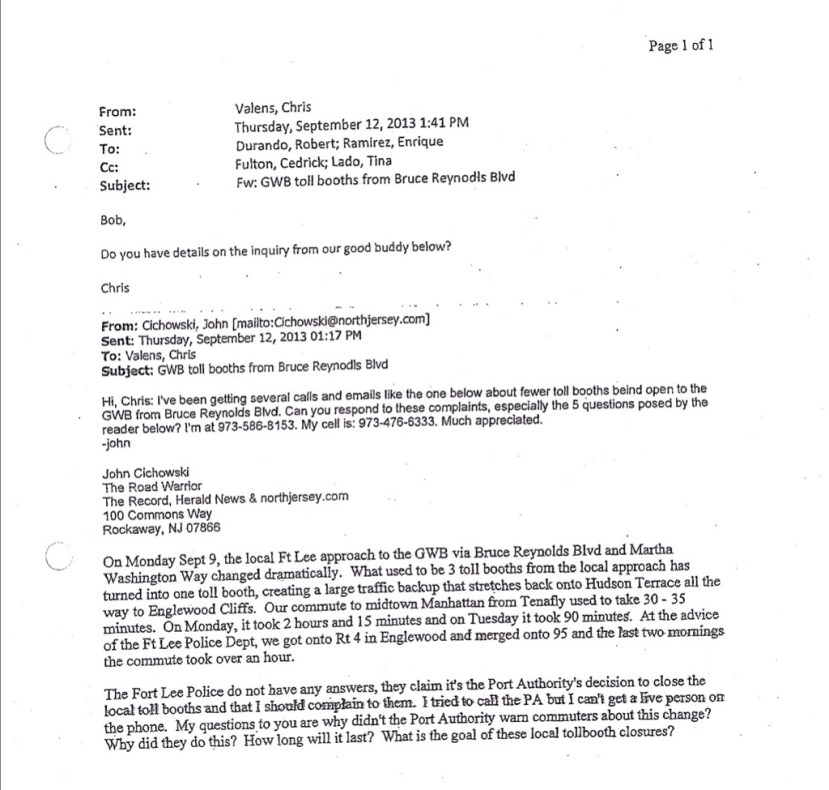
Update: The exhibits, which include numerous press requests and stonewalling of same, should be required reading in J school. The local press responded quickly with The Record’s Road Warrior columnist, John Chichowski, reaching out to the Port Authority on Sept. 12.
His piece the next morning led to the quick reversal of the ‘test’ causing the delays. Mann and others followed up, persisting for months, with FOIA requests that were ignored or pushed off, repeated queries from a variety of angles, and efforts to go directly to sources when the official spokesman blew them off.
The documents are worth reading for another reason: as a primer in bureaucracy and government.
“I will fight to the death for your right to say whatever you want. But I will never allow you to command me to publish what you have written.” — Cory Doctorow during reddit AMA, 1/10/14 http://pllqt.it/FNX4tt
Last November, I laughed with New Jersey Gov. Chris Christie as he joined in the joke during a Jimmy Fallon thank-you note for his reelection. The images of Christie making fun of himself there and, earlier that year, with David Letterman drowned out less pleasant memories.
Then it showed up on the Best of Jimmy Fallon special after weeks of reports about Christie’s bullying. Instead of laughing at what initially looked like an amusing nod to a personality quirk, I cringed as Christie shoved Fallon out of the way. Until then, Christie’s bullying was all about scathing comments.
When the correspondence was published this week linking Christie’s staff and appointees to the chaos-causing shutdown of the Fort Lee lanes to the George Washington Bridge, I didn’t see Christie in his Sandy blue fleece, tearing up at idol Bruce Springsteen or laughing at fat jokes. I saw this.
… there will always be a learning curve, and there will always be those of us who take the curve too fast and go plunging through the guardrail. The faster technology evolves, the more of us will end up taking the plunge. It’s comforting to think it will only happen to those who deserve it, but it’s far from the case.
One of the most popular new games of 2013 was an addictive mobile app called Dots: A Game About Connecting from Betaworks. It’s deceptively simple: a white board full of evenly spaced colored dots worth points when connected in a short amount of time. You can play instantly without reading the rules, or you can get immersive and obsessively strategic. You can play against yourself or against an expanding universe. You can play for free or you can buy ways to improve your game — but the choice is up to each player: earn your way to advancement or pay for it.
The game launched on iOS in May and had a million users within days. Now also on Android, it passed 15 million installs in November. By early fall, it had been played a billion times.
For the media in 2014, connecting the dots has to be more than a game. We have to connect the fragments of information that flood the zone daily. We have to connect with our communities. We have to connect with each other.
Each time I started my Nieman Lab 2014 look ahead, Steve Martin paid a call. Clad in his elegant suit, seated on the stage at Studio 8H, he solemnly proclaimed his one wish for all the children of the world to join hands and sing in harmony, then quickly segued to increasingly selfish and grandiose desires.
A diversionary tactic, true, but also a reminder of how easy it is to slip into pretension. Also of how easily we can scratch a retro video itch …
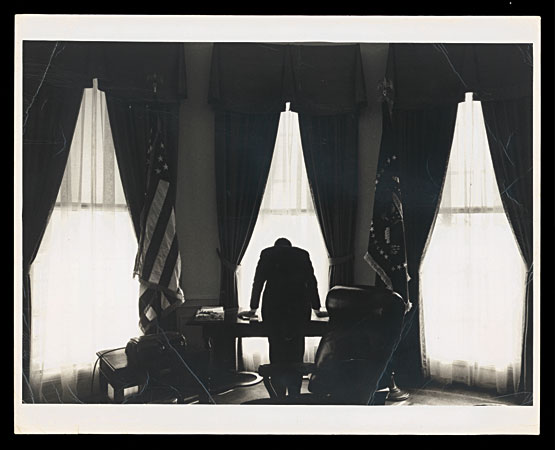
New York Times photographer George Tames captured this image of John F. Kennedy in the Oval Office on Feb. 10, 1961, only weeks after he was sworn in as president. Captioned ‘The Loneliest Job,’ Kennedy looks as though he is carrying the weight of the world on his shoulders in utter solitude. In one image you can see everything you need to know about the isolation and responsibility of the presidency.
In reality, it’s an object lesson, a reminder that the 1,000 words a picture speaks can be our projection. Kennedy broke his back in World War II and despite the glorious football photos that showed an agile, athletic young president, he was in constant pain. He stood at the table behind his Oval Office desk to read the papers — leaning down with his weight supported by his hands to get a closer look.
Knowing that doesn’t change the power of the image, which presages some of the days Kennedy would have in that office during the Cuban Missile Crisis and other moments of personal or public crisis. When I think of JFK, this is the last picture in my personal slideshow.
It’s also a reminder that what we see isn’t always what it is.
As soon as a teary Kolten Wong was spotted being interviewed in the Cardinals’ clubhouse following his Game 4-ending pick off on first base, you knew what was coming next: endless references to Tom Hanks’ incredulous, near-whiny moment in A League of Their Own:
But I much prefer the sage advice of Rosey Grier, the Los Angles Ram who tackled Robert F. Kennedy’s assassin, when he sang Carol Hall’s lyrics for Marlo Thomas in the groundbreaking Free to Be You and Me …:
When Grier, who became a minister, sings to the little boys, “I know some big boys who cry, too,” it’s a permit slip. Hearing — and seeing –– Griersing It’s All Right To Cry was a gender game changer, meant to help boys feel better about emotions and to make girls more comfortable with their own. Even so, when I played softball on an otherwise all-boy team, it was a matter of pride not to even wince when I was hit by the ball (sometimes intentionally) catching batting practice. (The coach instituted a “laps if you swear” rule since a girl was on the team; I finally swore, did my lap and the rule disappeared.)
Later as a young reporter at The Atlanta Journal covering my first murder trial, I got teary after a conversation with an editor after a series of long days. I wanted to write another story about it that seemed vitally important at the time; he wanted me to realize the case was over. A male reporter saw me trying to choke back the tears, put his hand on my shoulder and said, “I cried after my first one, too.”
His message was in sharp contrast to the senior female editor in another department who’d had to fight and scrape for every bit of respect; for her, crying was anathema — a raised flag that women couldn’t be taken seriously. I learned from both.
We continue to send mixed messages about tears. It’s still noteworthy when a man cries or, as in the case of Hilary Clinton on the campaign trail, when some women do. We look down on people who don’t cry at the “right” time and askance at those who cry when we think it’s not appropriate. Imagine if the U.S. Speaker of the House known for crying was Nancy Pelosi, not her successor John Boehner.
Above all, though, it’s human and when tears come at the height of emotion, it can be cathartic.
All i want to say is i'm sorry #CardinalNation I go out everyday playing this game as hard as I can and leaving everything on the field.



 Trust But Verify
