Media Companies Abruptly Shut Down quadrantOne

And another grand plan by major publishers bites the dust. Tribune, Gannett, the New York Times Co. and Hearst have shut down quadrantOne effective immediately. The agency was an attempt to scale local for national display advertising, harnessing the power of the four owners and others. The abrupt website notice

Important Information About quadrantONE

To all of our valued partners:

As a result of the many changes that have occurred in the digital advertising marketplace over the last several years, the owner companies of quadrantONE have decided to seek different paths for national display advertising. As a result, quadrantONE will wind down current operations.

We’d like to take this opportunity thank all of our affiliate and advertising partners who have worked with us over the last 5 years. It has simply been our pleasure to serve you.

Sincerely,

The quadrantONE Team

Chicago-based QuadrantOne launched five years ago this month as some of the leading newspaper publishers looked for ways to capitalize on their local reach by providing advertisers with ways to target across organizations. Joint ventures, particularly in the competitive media space, are notoriously difficult. Often the betting is on how long they will last, rather than can they succeed. In that respect, Q1 went a little longer than I might have expected, especially with Tribune’s financial woes and the management changes across the various companies.

Update: David Kaplan, who covered quadrantOne in depth for paidContent and knows the ad exchange biz upside down and sideways, has a piece up now at AdExchanger:

One cause, according to sources, was bickering among JV partners, including over the investment they would be willing to contribute to the company going forward. …

The disintegration could – in part – be attributed to growing internal programmatic strategies that create better yield than the assumed scale of the co-operative. Also, this may be a sign that exchanges are creating better yield these days. Why manage a separate exchange when you can go through existing exchanges such as Google’s DoubleClick Ad Exchange, PubMatic, Rubicon Project, AppNexus and so on, and receive comparable or better CPMs.

See comment above about JVs being “notoriously difficult” — then add in the usual problems of startups and the rapidly changing ad marketplace.

Disclosure: My brother Billy Kramer worked for quadrantOne in 2010-11 but is not one of those who lost their jobs with no warning today.

Larry Lessig on ‘Aaron’s Laws: Law and Justice in a Digital Age’

Earlier this week, Larry Lessig channeled his grief over the death of Aaron Swartz, who he calls his mentor, and his anger at the federal prosecutors and legal system that equated civic activism with felony, into a must-see talk at Harvard Law School. In the lecture to mark his appointment as Roy L. Furman Professor of Law and Leadership, Lessig showed us what made Aaron Swartz special — worth watching for that alone if you don’t already get it — then methodically took apart the current U.S. legal approach to hacking and showed how it could be put right. (He also gave a master class in how to use slides and multimedia.) Worth every minute.

Related: Aaron Swartz, Eugene Patterson and the Legacy of Ralph McGill

Aaron Swartz, Eugene Patterson and the Legacy of Ralph McGill

Beleaguered on so many fronts, the industry still shows evidence of an enduring public service mission and an apprentice tradition that lighted the way for editors like [Eugene] Patterson and those who followed. In Atlanta, Ralph McGill, a legendary anti-segregationist editor, tutored a young Patterson, sharpening his focus, prose and resolve. That man in turn grew up to teach and inspire future generations of editors, me included, even as the stories evolved from segregation to death penalty law, gender inequality, immigration and more.

[Aaron] Swartz was not a journalist, but a programmer turned crusader whose work raises large and complex questions about who owns knowledge. And his ideals could be in conflict with the news industry’s business views on copyright and content control. But they are rooted in a historic journalistic debate that Patterson would have recognized, one made ever more urgent by the digital possibilities: Who controls access to information? When to publish and when not? What are the costs — financial, moral and personal?

— Ann Marie Lipinski, Nieman Foundation curator, drawing a connection between the editor Eugene Patterson and hacker (in the best sense of the word) and activist Aaron Swartz, who died a day apart. You can — and should — read Ann Marie’s entire piece here.

I was thinking of Ralph McGill, a personal hero of mine, as I read Ann Marie’s thoughts, in part, because it is reflexive to think of him whenever I think of Gene Patterson or certain other graduates of the McGill school. Then I ran into his name in the section quoted above and was reminded of how far his legacy has spread, how many people still believe that journalism can and must be used to challenge the worst in our world, to change the status quo. Even those who don’t recognize the name (my mother would call that a shonda) have learned from those who do like Ann Marie.

Add to that another reminder: in today’s world, the power of one-to-many no longer belongs only to the media or the government. That doesn’t change the responsibilities of journalists; it spreads the responsibility of change.

Culture is not …

Culture is not about the furniture in your office. It is not about how much time you have to spend on feel-good projects. It is not about catered food, expensive social outings, internal chat tools, your ability to travel all over the world, or your never-ending self-congratulation.

Culture is about power dynamics, unspoken priorities and beliefs, mythologies, conflicts, enforcement of social norms, creation of in/out groups and distribution of wealth and control inside companies. Culture is usually ugly. It is as much about the inevitable brokenness and dysfunction of teams as it is about their accomplishments. Culture is exceedingly difficult to talk about honestly. The critique of startup culture that came in large part from the agile movement has been replaced by sanitized, pompous, dishonest slogans.

— product manager Shanley Kane speaks truth to power on concept of company culture. Worth reading it all, especially if you work for a startup or want to work for one but office politics and culture dynamics aren’t limited to places with Silicon in name. (h/t @palafo @al3x)

‘Can everything be part of a story?’

No, it cannot. Sports reveal character, but we can’t truly know if whatever drove an athlete to greatness was nobility or obsession or a hidden reservoir of rage. We can’t truly know what fame does to somebody. We can’t know a person, not really, no matter how many TV interviews or magazine features or newspaper columns they are in.Oscar Pistorius

Sports, and sportswriting, offers snapshots, glimpses, hints, or façades. Some of it is real, but none of it is ever comprehensive. We think we know, and we don’t, and we have to be reminded of this over and over again, because the lights are bright, and sports can be beautiful, and it causes us to forget, and believe again. Because we want it to be true.”

     — Bruce Arthur on the shattered image of Oscar Pistorius, charged with murdering Reeva Steenkamp. His full column.

Photo: Some rights reserved by Nick J Webb

Roll On, Columbia, Roll On

  1. On a Saturday morning 10 years ago, some of us got up to watch the space shuttle land — space flight an almost-routine occurrence as the sharp pangs of Challenger faded to memory. And then Columbia disappeared, jarring us out of that complacency about space flight, reminding a nation that years of safe roundtrips didn’t erase the risk, ripping the heart of NASA, changing families forever.  Mike Massimo, @Astro_Mike to those of us who follow him on Twitter, used the medium that didn’t exist a decade ago to share some of his memories about the people who got to live their dreams by flying through space on STS-107:
  2. Today is the 10 year anniversary of the Space Shuttle Columbia accident, I miss my friends but have awesome memories of each of them
  3. My favorite memory of Laurel Clark: taking our families together to the Children’s Museum in Houston, she was always fun to be around
  4. My favorite memory of Willie McCool: watching him give my one year old son a ride in a rolling chair through the halls of NASA
  5. My favorite memory of Rick Husband: eating his nacho recipe and hearing him talk about his family and flying jets, I miss you buddy
  6. My favorite memory of Dave Brown: going to wrap party for the movie “Armageddon” at the Kennedy Space Center and hangin with the movie stars
  7. My favorite memory of Kalpana “KC” Chawla: meeting and escorting her family during her first space launch at the Kennedy Space Center in ’97
  8. My favorite memory of Ilan Ramon is sharing Christmas together with our family and friends just before his spaceflight
  9. My favorite memory of Mike Anderson: flying in a T-38 together to Kansas and talking about spacewalking along the way, he was always smiling
  10. ‘Mission of Hope’ finds uplifting story within the shuttle Columbia tragedy – Cosmic Log cosmiclog.nbcnews.com/_news… via @NBCnews
  11. And from others inside the program and out:
  12. #InMemorial RT @FragileOasis
    Journey of the human spirit goes on. Earth’s moon from Space Shuttle #Columbia 26 Jan 2003 http://pic.twitter.com/IWER71Yh
  13. #inmemoriam The bright sun dissects the airglow above Earth’s horizon in this photograph taken on STS-107: http://twitpic.com/c01jp8
  14. 10 years ago today #Israel’s 1st astronaut Col. Ilan Ramon perished in Space Shuttle Columbia. We salute him. http://pic.twitter.com/hDnkSOTQ
  15. Thinking of the crews of Apollo 1, Challenger and Columbia today during NASA’s Day of Remembrance http://pic.twitter.com/es4nJBcr
  16. Remembering the crew of STS-107, aboard Space Shuttle Columbia, lost 10 years ago today. http://pic.twitter.com/plu46bvl
  17. #inmemoriam STS-107 Mission Specialist David Brown undergoes pre-flight training in a @NASA_Johnson airlock: http://twitpic.com/c02mju
  18. Un día como hoy pero del 2003 el transbordador COLUMBIA estalla al volver a la tierra http://pic.twitter.com/PNSaZATL
  19. * As far as I know, Woody Guthrie wasn’t thinking of flights to the moon when he wrote Roll On, Columbia. The song, sung to the tune of ‘Good Night, Irene’ is an ode to a then-contemporary major feat of engineering, combining the power of rivers with the majesty of the Grand Coulee Dam. 

Wrong Kind Of Comments Thrive In A Vacuum

If commenters think your commenting thread is a public space where they can do whatever they want because nobody’s watching, they will do whatever they want. And that is not pretty. And then the potentially constructive comments never get posted, because normal people do not want to waste their time thinking and writing comments that will just get flamed.

— Bora Zivkovic, blog editor of Scientific American in a thoughtful look at the state of commenting. (It would be even more thoughtful if the animated art had an off switch.)

“I did not …

“… I did not say this thing did not affect the CNET brand. I said that CBS was the brand that took the blame for what happened. Not disputing there was an effect on the CNET brand as a result of what happened. Nor are we saying we will just blink our eyes and act like this never happened. Just said we can get through it. ” — CBSi President Jim Lanzone in internal message to CBSi staffers via Jim Romenesko, who has the latest on this increasingly toxic situation.

Bad Lede. Bad. Bad.

In the midst of Manti Te’o-Lance Armstrong mania Friday night, a retweet from National Post sports columnist Bruce Arthur cut through the clutter:

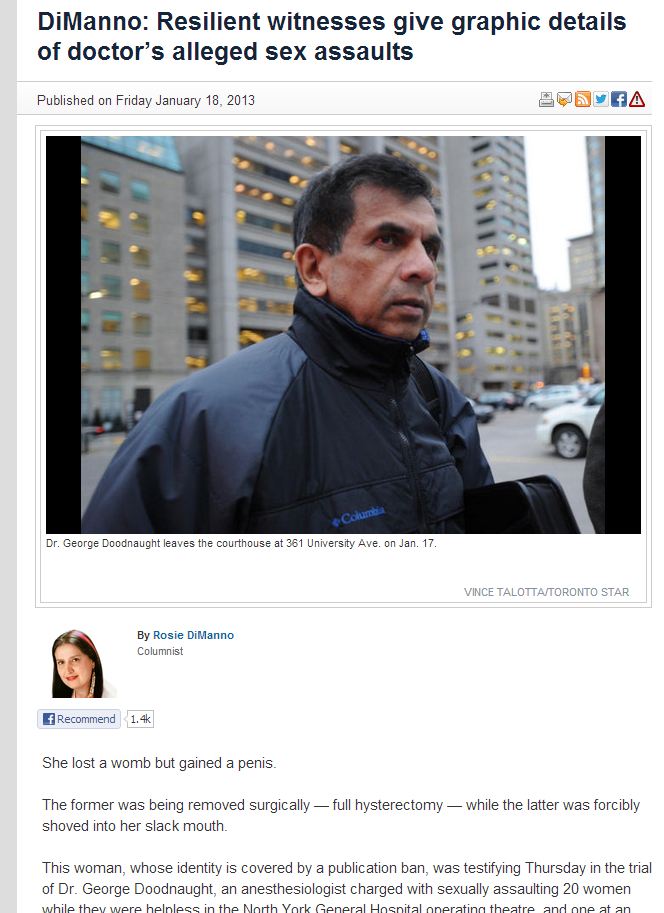
The link led to a journalism trainwreck written by Toronto Star columnist Rose DiManno:

Rosie DiManno lede

My first reaction, after doublechecking to make sure I read it right,

drew instant dismay:

Usually I move on but in the morning the lede was still in my head, like a bad hangover I didn’t enjoy getting. It was a bad lede, Bulwer-Lytton bad in its style but nothing to laugh at. It was especially bad for the delicate subject of a column about how a patient was sodomized on the operating table — a subject shocking enough without that intro. The column had other problems but they paled next to that lede. (I didn’t look at anything else Rosie DiManno wrote that day or her archives.) And it was the Toronto Star, a paper I took great pride in writing for as a hockey stringer but seemed to have no editors working that day. I couldn’t understand how it got published or, if it was the columnist pushing the button, how it stayed published.

I made another run at it:

More dismay via Twitter

but this time it also was picked up by Jim Romenesko, with the eye-catching headline “What the hell, Toronto Star?” and spread even more. Be sure to check out the comments.)

I didn’t reach out to the Star but after the considerable backlash from a lot of directions, including complaints to the paper, Public Editor Kathy English weighed in. She put it a lot more carefully but essentially it boils down to

“Rosie is a top columnist, we let Rosie be Rosie but if someone had noticed this before publication Friday we might have encouraged her to be slightly less Rosie.”

Those are my words. Here are some of hers:

“Taste” is always a subjective matter and questions of taste in columns and other content are often flagged to the managing editor by columnists themselves or other editors. That did not happen in this case. Had that occurred, I expect the managing editor would have urged DiManno to revise the opening to the column, which otherwise accurately reflects the direct testimony of the victim.

So what should the Star have done?

You don’t suspend a columnist for bad writing that gets published — that’s in the range of responses to plagiarism, bad reporting or bad behavior. If the columnist has the right to publish directly, I would change that — possibly with procedures in place to avoid being stonewalled by the editing process for something breaking.

This was an editorial breakdown. I would find out how it happened and look to the editor who approved it and/or the editor who set up a process that allowed it to happen. I would see if it’s part of a bad pattern and if more than the one column needs addressing. I would include copy editing, line editing and top editing in that look. If I caught the lede live — within hours of publication — I would have it updated and noted. At this point, I would add an editor’s note mentioning the concerns and linking to the public editor’s post. (The post link is there now as a related link but nothing is appended.)

Columnists need to have a voice and the best editors know how not to mess with that. They also know how to help the columnist use that voice and when to say enough is enough.

CBS Limits On CNET Editorial Independence Cause More Damage

A ham-fisted decision by CBS to force its tech news network CNET not to review devices that are part of active litigation looked bad when it emerged late last week. Now a new report from CNET competitor The Verge shows that the damage by CBS runs even deeper.

According to sources familiar with the matter, the Hopper was not simply an entrant in the Best of CES awards for the site: it actually was chosen as the winner of the “Best of Show” award (as voted by CNET’s editorial staff).

When CBS corporate found out, The Verge says, orders were sent to the edit staff to revote. They attribute it directly to the office of CBS CEO Leslie Moonves, the same CBS exec who acquired CNET in 2008 for $1.8 billion and championed its value.

Moonves is also fiercely opposed to anything that strikes at the economics of CBS and the company is among those suing Dish over the family of ad-skipping DVRs that CNET’s editorial review staff finds so appealing. Whoever thought it would look bad in court if CNET gave the newest Hopper the CES seal of approval as “Best in Show” had no clue how bad trying to stop it would look. In the immortal words of Julia Roberts, “Big mistake. Huge.”

Fallout starts

The way CBS interceded in CNET editorial accomplished something other news orgs have been unable to do: convince veteran CNET reporter Greg Sandoval, who I know has been recruited often, to leave.

This specific event doesn’t reflect badly on any of the reporters at CNET. But now that CBS execs have shown how willing they are to reach in and twist CNET editorial, Greg is right to realize that anything and everything can start to seem suspect. That doesn’t mean I think less of the reporters and editors who stay but I understand why he feels the need to go.

More to come.