Category: Sports
‘i really, REALLY didn’t realize people hated women this much’
One side effect of the NFL’s punt on Ray Rice: the reaction to the reaction sent a torrent of nastiness at women in sports media who spoke out, most notably Sam Ponder and Michelle Beadle. Unfortunately, that’s not new behavior, merely a new reason, but it was enough to grab the attention of some men who previously shrugged it off. The same afternoon that ESPN announced that, despite his apology, Stephen A. Smith would be off the air for a week after suggesting domestic violence is the victim’s responsibility, his colleague Bomani Jones took to Twitter to explain why enough was enough for him:
Tweets by @sdkstlIt’s All Right To Cry
As soon as a teary Kolten Wong was spotted being interviewed in the Cardinals’ clubhouse following his Game 4-ending pick off on first base, you knew what was coming next: endless references to Tom Hanks’ incredulous, near-whiny moment in A League of Their Own:
But I much prefer the sage advice of Rosey Grier, the Los Angles Ram who tackled Robert F. Kennedy’s assassin, when he sang Carol Hall’s lyrics for Marlo Thomas in the groundbreaking Free to Be You and Me …:
When Grier, who became a minister, sings to the little boys, “I know some big boys who cry, too,” it’s a permit slip. Hearing — and seeing –– Grier sing It’s All Right To Cry was a gender game changer, meant to help boys feel better about emotions and to make girls more comfortable with their own. Even so, when I played softball on an otherwise all-boy team, it was a matter of pride not to even wince when I was hit by the ball (sometimes intentionally) catching batting practice. (The coach instituted a “laps if you swear” rule since a girl was on the team; I finally swore, did my lap and the rule disappeared.)
Later as a young reporter at The Atlanta Journal covering my first murder trial, I got teary after a conversation with an editor after a series of long days. I wanted to write another story about it that seemed vitally important at the time; he wanted me to realize the case was over. A male reporter saw me trying to choke back the tears, put his hand on my shoulder and said, “I cried after my first one, too.”
His message was in sharp contrast to the senior female editor in another department who’d had to fight and scrape for every bit of respect; for her, crying was anathema — a raised flag that women couldn’t be taken seriously. I learned from both.
We continue to send mixed messages about tears. It’s still noteworthy when a man cries or, as in the case of Hilary Clinton on the campaign trail, when some women do. We look down on people who don’t cry at the “right” time and askance at those who cry when we think it’s not appropriate. Imagine if the U.S. Speaker of the House known for crying was Nancy Pelosi, not her successor John Boehner.
Above all, though, it’s human and when tears come at the height of emotion, it can be cathartic.
How To Hack Google: The Wikipedia World Series Edition
Look up “St. Louis Cardinals” or :”Cardinals” on Google right now and this is what you’ll see:
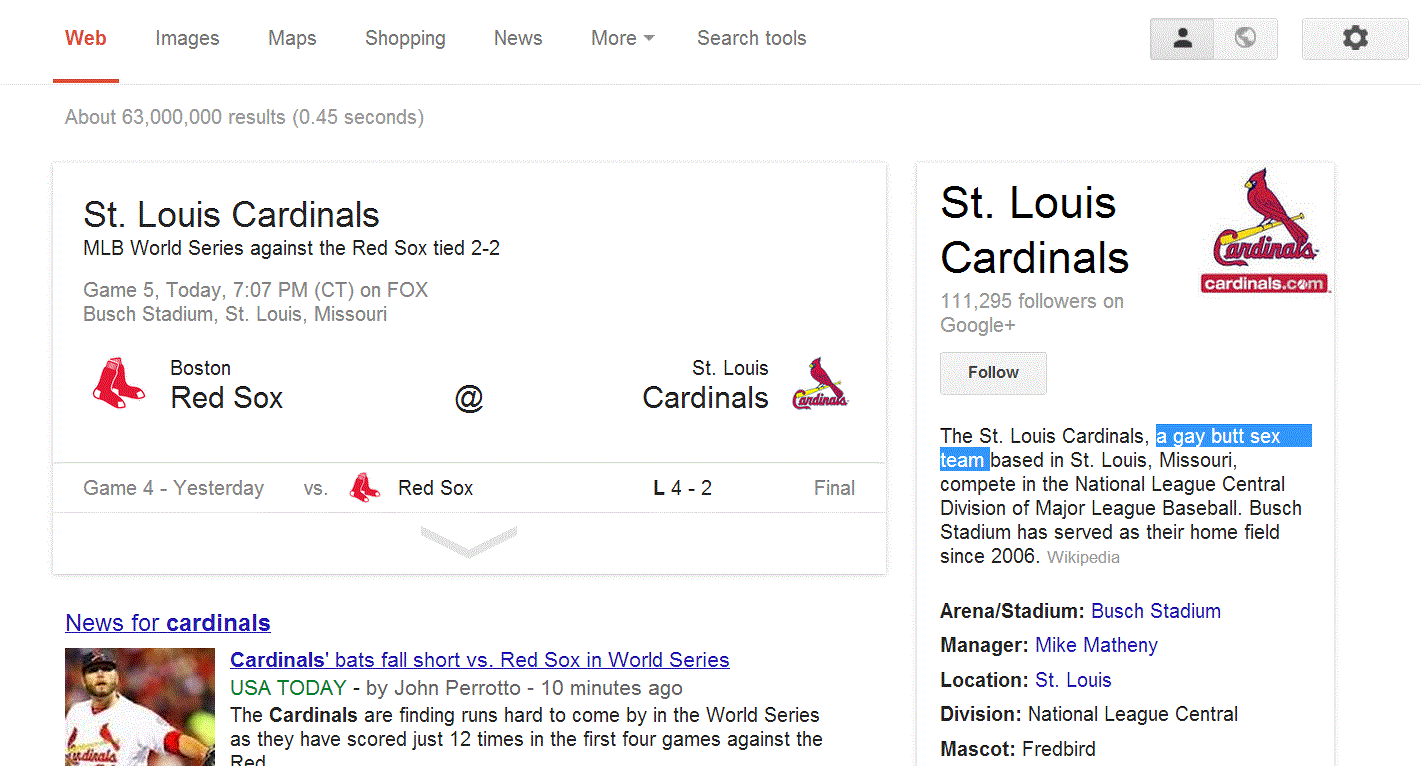
The description of the “gay butt sex”* Cardinals is an indirect hack of Google display space, made possible by reliance on Wikipedia. Change the Wikipedia entry and you can change the way something is perceived on Google and other sites piping in Wikipedia info.
The vandalized Wikipedia entry is back to “professional baseball team” now but the Google box on the Cardinals, playing the Boston Red Sox in Game 5 of the World Series tonight, has yet to catch/cache up.
* Yes, it is pathetic that this is still used as an insult.
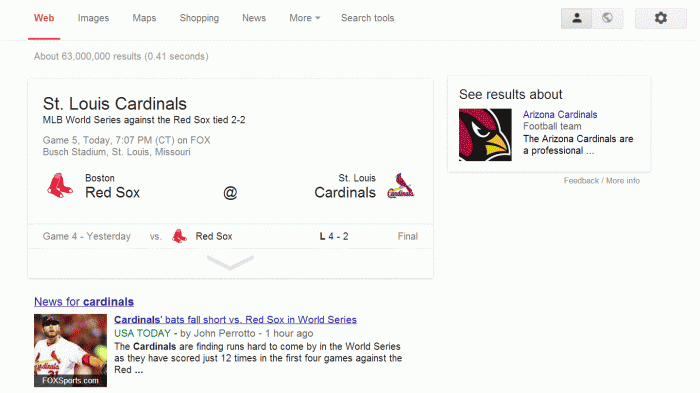
Updated: The vandalized version was still showing on Google 90 minutes after this posted. Now it’s missing — literally. The box on the right has been removed, leaving this view at 6 pm CDT:
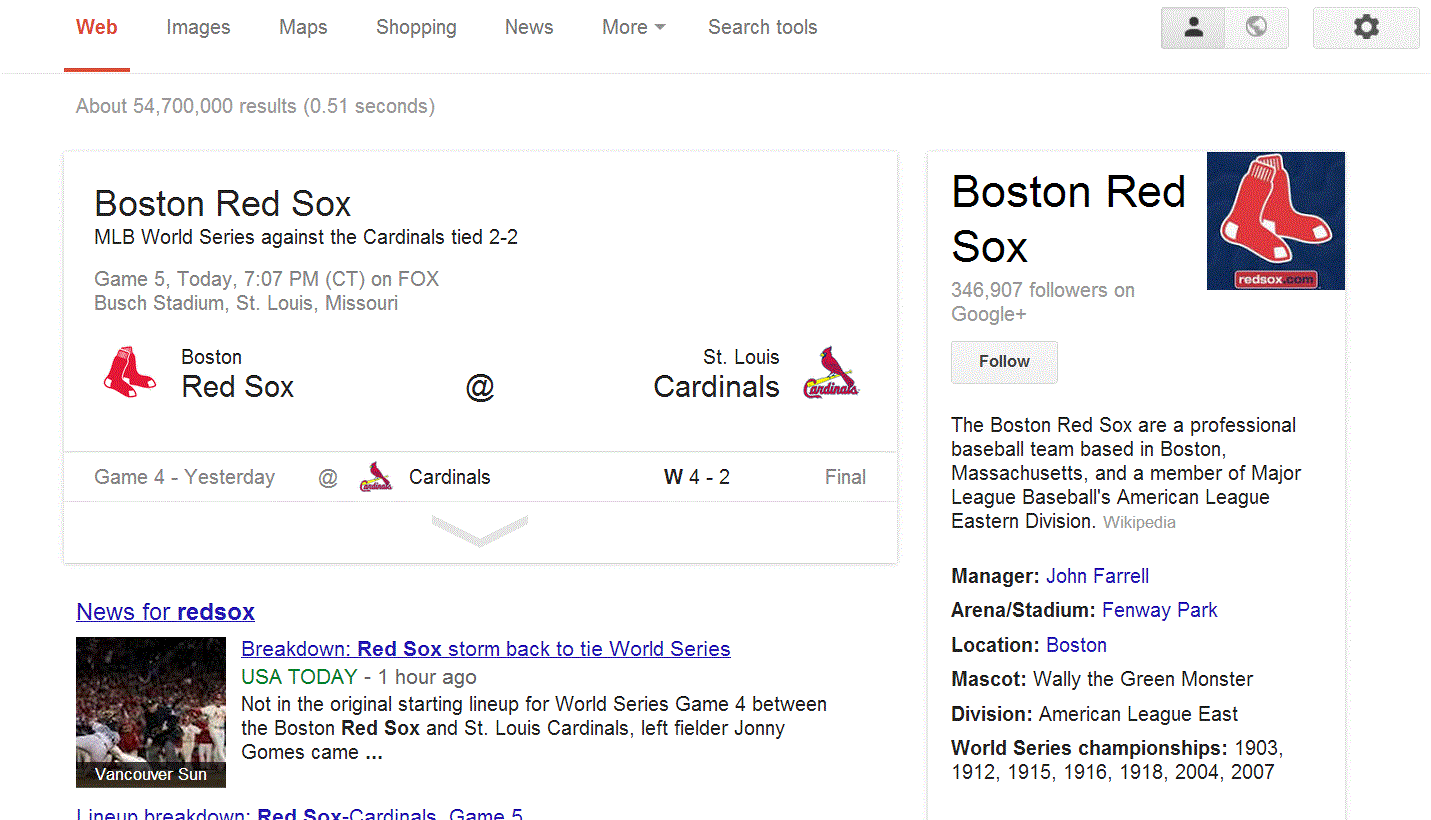
For comparison, here’s the Red Sox search result:
10/30/13 Update: Google told Gary Price at Search Engine Land that the problem in the Google Knowledge Graph box was “a technical issue on our end that let outdated information through.” Price is intrigued by how Google’s crawler managed to catch the vandalized Wikipedia entry, which was up only briefly. I’m still interested in why it was wrong for hours on Google and why it had to go the band aid route by removing the box temporarily.
NASCAR’s Social Media #FAIL
A horrific crash at Daytona Saturday afternoon sent more than a dozen fans to the hospital. The drivers involved walked away — almost unbelievably so in the case of rookie Kyle Larson, who emerged from less than half of his car after the rest went into the fence and the grandstand.
It also sent a lot of fans to social media with video and stills of the crash and its aftermath; many of them taken as eyewitnesses from the grandstands where the wreckage landed. Tyler Andersen, who describes himself on Twitter as a sophomore at Providence, posted a video that captured the whole sequence, including a tire that spun into nearby seats injuring someone near him and efforts to get assistance. He asked for prayers for the injured man before alerting ESPN to the video.
@espn here’s the video of the crash from my seats…. #Drive4COPD m.youtube.com/#/watch?v=wVW6…
— Tyler(@TAndersen904) February 23, 2013
Andersen’s video quickly ricocheted, recommended to me by disparate parts of my timeline. I watched it once and when I went back to check something minutes later, it was gone.
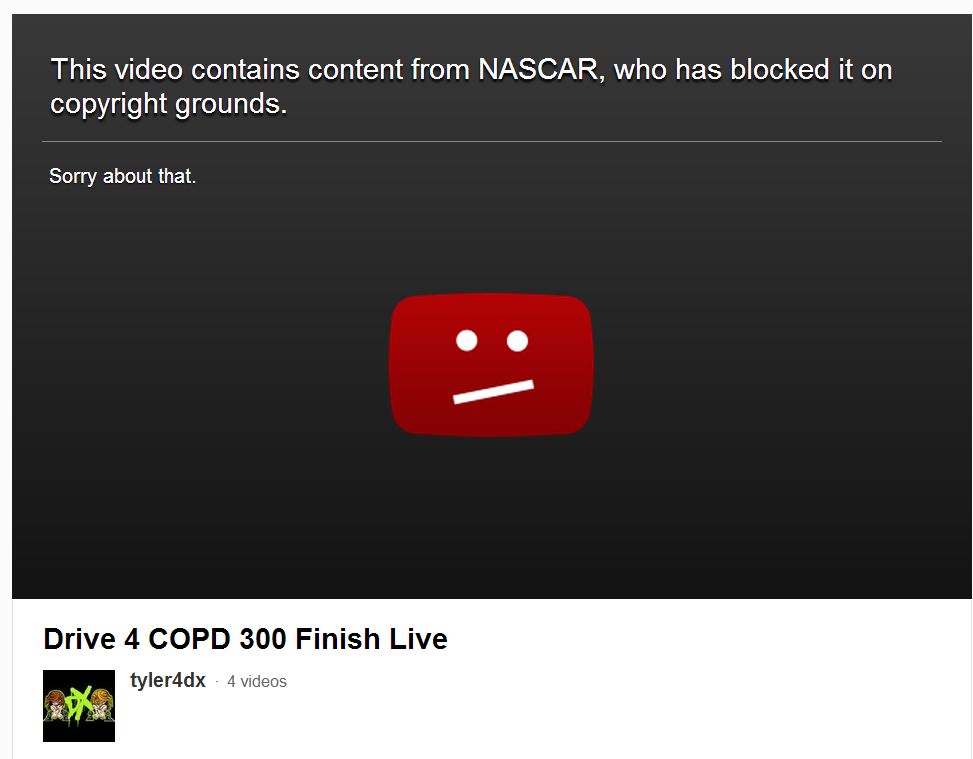
I don’t know if this was the automated YouTube copyright police at work or if it was taken down because NASCAR or a media rightsholder complained. If it was the former, NASCAR has a sophisticated enough social media operation to know that the video was yanked and should be back up. If it was the latter, NASCAR has a sophisticated enough social media operation to know that rights or no rights, the video wasn’t going away and they might as well avoid the criticism of it.
.@nascar has nearly 1 million Twitter fans. more than 3 million likes on Facebook. That genie isn’t going back in the bottle.(Update: It was overt.See NASCAR’s explanation below.)
— Staci D Kramer (@sdkstl) February 23, 2013
Instead, news video taken by someone who narrowly missed being injured) was blocked — and as of this writing is still blocked. Meanwhile, Deadspin (of course, it was Deadspin), smartly grabbed a copy of the video and popped it right up.
Yes, NASCAR owns the copyright, something spelled out on tickets to races just as it is for many other events.
Re. NASCAR’s right to fan video: Note what every ticket says: ow.ly/i/1zBO3(Via @michaelprocton, @magnetion)
— Jay Busbee (@jaybusbee) February 23, 2013
(There are legal concerns here; I expect all of the video, stills and other records could be evidence in any case emerging from the crash.) And I can understand setting up rules applying it to live streaming or layering in length limits.
I agree with Anthony De Rosa:
Anyway, rights to media at NASCAR far less important issue than status of fans injured
— Anthony De Rosa (@AntDeRosa) February 23, 2013
And I’m not encouraging any fan to take video or pictures at personal risk or to do it instead of helping those around them if that is possible.
But this dynamic isn’t going away. For instance, at least one other video of this crash is up now (via SBNation)
Taking high-quality images and instantly sharing them is only getting easier. If NASCAR wants the boost from social media, as it clearly does given its interaction on Twitter, Facebook and other places, it should go all in.
@sdkstl @nascar As John Gilmore says, “The Internet interprets censorship as damage and routes around it.”
— slfisher (@slfisher) February 23, 2013
As for the video of today’s crash, my initial response after the takedown, shared or favorited by dozens, stands:
.@nascar Strongly urge you to unblock fan video of Daytona crash. If you want the boost from social media, need to take it all.
— Staci D Kramer (@sdkstl) February 23, 2013
Update: As I was posting this, The Verge published a statement from NASCAR that it took down the video out of respect for those injured.
Information on the status of those fans was unclear and the decision was made to err on the side of caution with this very serious incident.
See above.
Meanwhile, Andersen, whose Twitter feed reflects being overwhelmed by the emotions of the afternoon,
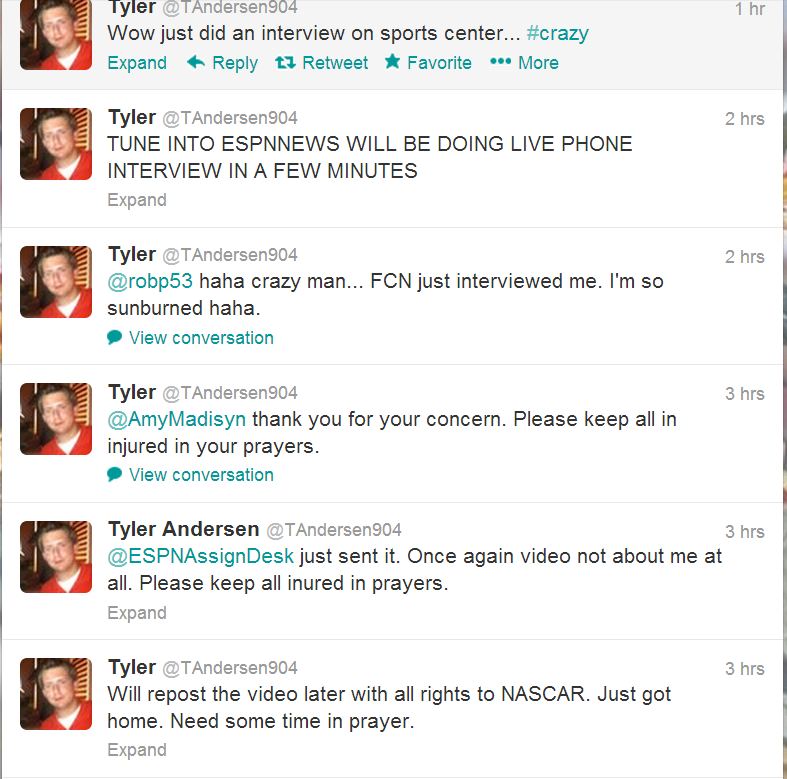
added this:
Can fully understand why NASCAR took the video down. Meant no disrespect to any involved. Once again, keep all affected in your prayers.
— Tyler(@TAndersen904) February 24, 2013
Update 2: And YouTube saves NASCAR from having to reverse its decision by reinstating the video, telling the Washington Post’s Erik Wemple:
Our partners and users do not have the right to take down videos from YouTube unless they contain content which is copyright infringing, which is why we have reinstated the videos.
Will NASCAR try the copyright block again using the language on the ticket that claims it owns all rights? I hope not. Will other copyright owners get the message from YouTube that takedowns aren’t an accepted method of trying to control the flow of information? I doubt it.
I also doubt NASCAR is at risk if losing its YouTube account but the Google video portal lists that as a possible consequence of misusing the power of DCMA:
If you choose to request removal of content by submitting an infringement notification, please remember that you are initiating a legal process. Do not make false claims. Misuse of this process may result in the suspension of your account or other legal consequences.
Related: NASCAR Exec Says Crash Video Takedown Was Exception, Not Rule
‘Can everything be part of a story?’
No, it cannot. Sports reveal character, but we can’t truly know if whatever drove an athlete to greatness was nobility or obsession or a hidden reservoir of rage. We can’t truly know what fame does to somebody. We can’t know a person, not really, no matter how many TV interviews or magazine features or newspaper columns they are in.

Sports, and sportswriting, offers snapshots, glimpses, hints, or façades. Some of it is real, but none of it is ever comprehensive. We think we know, and we don’t, and we have to be reminded of this over and over again, because the lights are bright, and sports can be beautiful, and it causes us to forget, and believe again. Because we want it to be true.”

— Bruce Arthur on the shattered image of Oscar Pistorius, charged with murdering Reeva Steenkamp. His full column.
Photo: Some rights reserved by Nick J Webb
White Sox Win! White Sox Win!
And it only took 88 years. As a baseball fan, I don’t like to see a sweep but as my father’s daughter couldn’t be happier. Even my mother, the born-and-bred Cubs fan — I come from a mixed marriage — is thrilled. Too, too cool.
Hullie skates off
Strange to walk in from dinner and find out via the ESPN scroll that Brett Hull’s stellar career came to an end tonight in Phoenix; like many other NHLers of a certain age who had more hockey in them following 2003-04, the long lockout layoff was too much for the now 41-year-old Hull. He knew, as did anyone who has followed his career, it would be his last hurrah when he signed on with best friend Wayne Gretzky’s Phoenix Coyotes in August 2004. But who would have guessed it would come to an end after only five games and one assist, that he would retire wearing the sweater of the team he played with for the fewest games?
This year’s record forms an odd set of bookends with his first year in the NHL back in 1986-87, when he played five games and earned one point (from a goal). He left for St. Louis during the following season, arriving with 27 goals and 24 assists to his name. Bobby Hull’s son came into his own in St. Louis, developing from a chunky kid with promise and a famous name into a top-flight player, record-breaker and blunt speaker. I remember sitting a row back from him during a Bruce Springsteen concert at the Arena in his early days here; only a few of us even knew who he was. A year later, the right wing could barely move through the building without causing a ripple of excitement. Eventually, the Arena’s replacement was dubbed the "House That Hull Built." In 1990-91 he scored 86 goals and 45 assists in a mere 78 games. He broke 100 points four years running and with center Adam Oates provided one of the most electric playmaker/goal scorer duos the game has seen. (I’ve often wondered what the records would look like if the tandem hadn’t been cut short by Oates’ career choices.)
Only Gretzky and the great Gordy Howe scored more goals in the NHL than Brett Hull, who leaves the game with 741 goals, 650 assists, 1,391 points and 458 penalty minutes in 1,269 games. For trivia buffs, father Bobby ended his career with 610 NHL goals. They are the only father-son with 50 goals in a season, 600-plus goals apiece and, as follows, the highest-scoring father-son tandem. Bobby’s number "9" was retired by the Winnipeg Jets. This season, it was unretired by the team now known as the Phoenix Coyotes so it could be worn by his son.
Trying to quote Hullie often meant sorting out the words that could be quoted in a family paper from his typical stream of f* laden consciousness but he almost always could be counted on to say something worth printing. He’d look at you with a "do I have to" stare, raise an eyebrow and go, sometimes interviewing himself. His sense of humor was, is demonic, his flair on the ice unmistakable. His joy in being a father was as much a gift to watch as his game on the ice. He went on to win his Stanley Cups in other uniforms but the bulk of his goals and the bulk of his playing years were spent here — and we were the luckier for it. Of course, it would have been even better if he’d managed to lead the Blues to the promised land.
Red Sox ride is over; White Sox take their turn
I watched the last two games of the 2004 World Series from the press box at Busch Stadium — actually the auxillary box as an embed with the SI crew, who made room for a Christian Science Monitor credential holder otherwise slated for the way auxiliary outfield seats. They weren’t pleasant games to watch for Cardinals fans or anyone who loves a good baseball game. You go to the World Series hungry to see the best, not a team that doesn’t live up to expectations. I wasn’t there as a fan but the disappointment seeped through the stadium, a miasma that was hard to shake on and off the field — unless you were wearing red because you were part of Red Sox Nation.
Being on assignment for the Boston-based Monitor, I skipped the truly awful trip into the losing clubhouse (been there) for the champagne-soaked chaos of the visiting clubhouse. I wound up walking through the dugout behind the legendary Johnny Pesky, emerging while he was still being cheered. Red Sox players twirled their small children on the third base line; others took turns with cameras. It was an amazing moment to witness and an odd one. After all, this was the same field I stood on after Mark McGwire broke the home run record and yet for a moment it was Fenway in abstentia.
Today, Red Sox Nation came back to earth. They were in the real Fenway, watching another legendarily hapless team celebrate a sweep over the 2004 World Series champs — and in the first round. the first playoff series win since 1917 One stunned man sat motionless, with a kerchief over his face; another rubbed the back of a heartbroken boy while the winning team partied obliviously on and off the field.
It’s the White Sox Nation’s turn and the displaced, lifelong White Sox fan I call Dad is savoring every minute. When the White Sox meet the Cardinals in the World Series, I’m rooting for seven games worth remembering.
No Women Voters For This Year’s BCS Poll
Every so often, something pops up on my radar to remind me how much further women have to go when it comes to sports. The latest example comes from Joanne C. Gerstner, president of AWSM (Association of Women in Sports Media): the 114-member panel voting on the weekly ranking for the BCS does not include a single woman. AWSM quickly expressed its concerns to the BCS and to Harris, which is administering the poll. According to the BCS, the 300-person pool — from which Harris randomly selected the participants — included "a few women." The nominees from each conference were supposed to be former coaches, players, administrators and media.
No recourse for this year but AWSM has been asked to contribute potential panelists for next year; it’s not a guarantee of inclusion but at least the pool will start off with a higher potential to include some women panalists. (That’s assuming the controversial BCS poll doesn’t implode before then.) As Joanne wrote to members: "We need to get involved, so there are no excuses for
future panels. We demand women be represented."
Women certainly are represented in other ways when it comes to college football — as journalists, administrators, cheerleaders, season ticket holders, merchandise buyers, just to name a few. We shouldn’t have to demand that women be represented in the BCS or similar endeavors but we still aren’t anywhere close to a time when that might be the case.
The same newsletter included a new PayPal option for renewing dues. Done.
Coda: It was 25 years ago this summer when I had the chance to shadow Atlanta Journal baseball writer Tim Tucker. My first trip into the Braves clubhouse was memorable, to put it mildy. Three years earlier, SI’s Melissa Ludtke bravely pushed back when Bowie Kuhn excercised his power as commissioner of baseball and told her she couldn’t cover the World Series alongside her male colleagues; the locker room was off limits. She went to court backed by Time Inc. and won in time for the 1978 World Series. In response, Braves owner Ted Turner bought his players bathrobes to wear whenever women were announced. The problem the night I went in: someone decided it would be more fun not to make the announcement. We all survived.
USA Today Trusts — But Doesn’t Verify
USA Today relearned a tough lesson this week when large chunks of a feature story published Aug. 8 about a businessman turned out not to be true. A quick search or two might have saved the paper from a great deal of embarrassment — not that search engines are infallible but they are a good place to start, especially when the details being offered include being a Boston Bruins’ draft pick, a Harvard hockey player and a number of other items likely to be logged in multiple places. Instant red flag if the name doesn’t turn up anything close. Instead, the inconsistencies came to light after publication; the paper published a follow-up today including an apology from a publicist but no apology of its own.
Steve Outing posted a correction today — and a mea culpa — for a post he made on Wikipedia based on what turns out to be a flawed Reuters’ article based on a German-language newspaper report based on an interview in English with Wikipedia founder Jimmy Wales. He wasn’t the only one to pick up the story that — erroneously, according to Wales — said a change in policy was on the way that would freeze some articles. (Though, as far as I know, he’s the only one to correct it.) I saw the same story and put it aside until I could find out more but I just as easily could have popped it online without doing any legwork. After all, it was an interesting report from a trusted source; I post items on that basis all the time.
It’s almost tangential but I might as well bring it up before someone else does. Both of these cases are about mainstream media making mistakes. I can hear the comments now — I’ve seen enough of them — how can they complain about bloggers getting it wrong when they make mistakes like this? I’ll go back to kindergarten for this one: two wrongs don’t make a right. Sloppiness or mistakes in one category don’t excuse similar behavior in another. The difference here is that while it would be morally and ethically nice if everyone checked out everything before they post it — and, in most cases, a quick check or a moment’s thought would be deterrent enough — it’s the journalist’s job to do it. Even so, anyone who abuses the reader/listener/user/viewer’s trust will lose it no matter what they call themselves.
How far do we go in checking something out? How much do we challenge? How do we use information that should be shared but may not be provable? How do we decide when not to include information we know to be true? We hold a story back if it doesn’t ring right. We make judgment calls. We attribute. Inevitably, we have to take some things on face value. We correct our mistakes. And we try very hard not to make the same mistake twice.
Coda: I was about to post this when I did another search and found this story by Mike Eidelbes at InsideCollegeHockey.com, who saw the original USA Today piece and then started seeing red flags as he went from resource to resource without turning up Larry Twombly. He contacted USA Today reporter Stephanie Armour and was told they’d found discrepancies.
 Trust But Verify


