Pushed by CBS, CNET Drops Dish Hopper From CES Awards

My first reaction when I heard CBS banned the Dish Hopper with Sling from the CNET Best of CES awards was it has to be a mistake.

Unfortunately, it’s true — and yes, it is a mistake. It may be legally pragmatic to avoid giving the opposition in a lawsuit homemade ammunition but the CBS corporate decision to ban reviews of products it is in litigation over may do more lasting damage.

CNET Best of CES promoCBS and other programmers concerned by the potential economic impact of the “record anything, watch everywhere with easy ad skipping” technology used in the Dish Hopper are suing over the device and the concept. That’s going on at the corporate level. At CNET, litigation like that is a running news story, the kind you try to be objective about and post with the right disclosures to make sure your readers get the news and info they need.

CNET, which has a near-impeccable reputation for independent reviews, reviewed the device and liked it so much that it wound up as a finalist for a 2013 Best of CES award. The review, with the headline “Dish Hopper with Sling: HD DVR almost has it all,” is still up but the device was yanked from the awards lineup. The review and the awards page have this statement now at the bottom:

The Dish Hopper with Sling was removed from consideration for the Best of CES 2013 awards due to active litigation involving our parent company CBS Corp. We will no longer be reviewing products manufactured by companies with which we are in litigation with respect to such product.

That’s the same statement I got from CNET PR when I asked about the decision. The statement stresses reviews, separating that aspect of CNET from news coverage. There’s no editor’s note on the Dish press conference post from CES.

It’s a legalistic sleight of hand that doesn’t really work. Instead, CBS undermined CNET’s credibility and diminished one of the tech news site’s marquee events by trying to avoid a positive note for Dish that could show up in court.

Meanwhile, Dish gets to brag about the device and take a jab at CBS at the same time via a press release about the disappointment. Dish frames its argument for the Hopper and similar battles with programmers as Dish=consumer. This statement from the release is a shining example:

“We are saddened that CNET’s staff is being denied its editorial independence because of CBS’ heavy-handed tactics. This action has nothing to do with the merits of our new product. Hopper with Sling is all about consumer choice and control over the TV experience. That CBS, which owns CNET.com, would censor that message is insulting to consumers.

DISH is not afraid to stand up for consumer rights and we think that Hopper with Sling will do well, despite the network’s questionable actions.”

This isn’t just about Dish. It covers reviews of products from any company CBS is suing or is being sued by. For instance, this new CBS-mandated policy would block reviews of products from Barry Diller-backed Aereo, the over-the-air-to-broadband streaming video service CBS and other networks.

It’s actually limited to active litigation so might not happen often but unless CBS finds a way to walk this back, it will continue to erode CNET’s credibility and authority.

The Thin Line Between Chilling And Thrilling

Listening to the cafe theorists transform into revolutionaries as we saw Les Miserables for the first time, I flashed back to another musical turned movie and another song as a rallying cry for political change — the clear young voice shimmering from a beautiful blonde boy as he declares Tomorrow Belongs to Me. A bucolic country moment turns into one that sends shivers as Germans of all ages join in song and we realize the deepest danger isn’t from the Nazi leaders; it’s from the people who stand with them. It is more chilling in many ways than the ugliness we will see later because it makes that ugliness possible.

The anti-royalist revolution in Les Miz is not the one that succeeds but ultimately fails itself, choking on blood and power lust. It follows that French Revolution by decades and it fails as it begins. We fear what’s ahead from the singers in Cabaret. In Les Miz, as Do You Hear the People Sing? and its message about “when tomorrow comes” continues the call to revolution started with ABC Cafe/Red & Black, we fear for the lives of Enjolras, Marius, Gavroche and the other brave, naive revolutionaries. It helps that their most visible foe is an army, not the less powerful.

We want to believe in the people manning this barricade and we grieve with Marius over the results.

A thin line.

Jason Kilar’s Epitaph As Hulu CEO: He Made It Work

The quickest way to set off at least one media exec I know is to praise Jason Kilar for making Hulu work. I can almost set a timer for the refrain. Look at what he had to work with — content from equity partners NBC Universal & Fox , eventually joined by Disney, plus many other key content and distribution deals done before he entered the picture.

Fair enough. Amazon vet Kilar,  who announced his long-anticipated departure as CEO of the video portal today, had a lot to work with when he was hired in the summer of 2007 to make sure NewCo, known as ClownCo in media circles, didn’t fall flat. The launch valuation of $1 billion, cemented by a $100 investment from Providence Equity Partners, preceded him too. He had top-level champions who wanted to see Hulu work in News Corp. COO Peter Chernin and NBCU CEO Jeff Zucker, and other key execs at the founding partners who were committed enough to overcome those who weren’t. (You can’t overestimate the value of knowing that the CEO had to come from outside their companies and from a different perspective for the joint venture to have a prayer.) And there are a lot of ways you can gauge his success or failure; he looks better by some measures than others. 

But by one very important measure, Kilar did a lot right. Unlike a lot of other bright media ideas (and plenty that weren’t so bright), particularly those requiring cooperation across usually competitive companies, Hulu launched and grew. It avoided the tech meltdowns that could blunt consumer interest, starting with a highly usable player.  Kilar drove some distribution partners crazy and precluded deals with others by insisting on that proprietary video player. He also angered some consumers, particularly cord cutters, by keeping tight controls on the way Hulu was delivered.

As a private beta user turned Hulu Plus subscriber, I’ve seen my share of glitches but from the start it simply worked without the level of frustration I’ve felt with so many other media products. (Amazon Unbox, anyone?) A lot of people contributed to that but Kilar’s often single-minded insistence on the best user experience possible, including pushing back the public launch by months, was at the core. That sounds like such a basic, common-sense thing — but technology, common sense and television network all too often are words that don’t belong in the same sentence.

Bad user experience can tank a startup but, as is the case with access to top content, a good one is no guarantee of success. It takes more than content and usability to build a 600+ person company with nearly $700 million in revenues last year, high-profile  placement across devices and platforms, and a growing paid subscription base. In his blog post announcing plans to leave this quarter, Kilar said Hulu added a record 200,000 subscribers in the past seven days; he claimed more than 3 million Hulu Plus subs in his Dec. 17 year-end report.

Kilar leaves with some lovely parting prizes, including a reported $40 million buyout of his equity following the partners’ decision to stay in the video portal business for now, and a high ranking in the media-tech CEO candidate pool. My educated guess is that he will take a family break before a next public step.

As for Hulu, the choice Disney and News Corp. make for a successor  (Comcast NBCU is still on the post-merger sidelines) should say a lot about the video JV’s post-Kilar direction. Think money, not product.

Some Ads Don’t Make Good Neighbors

Some Ads Don't Make Good Neighbors

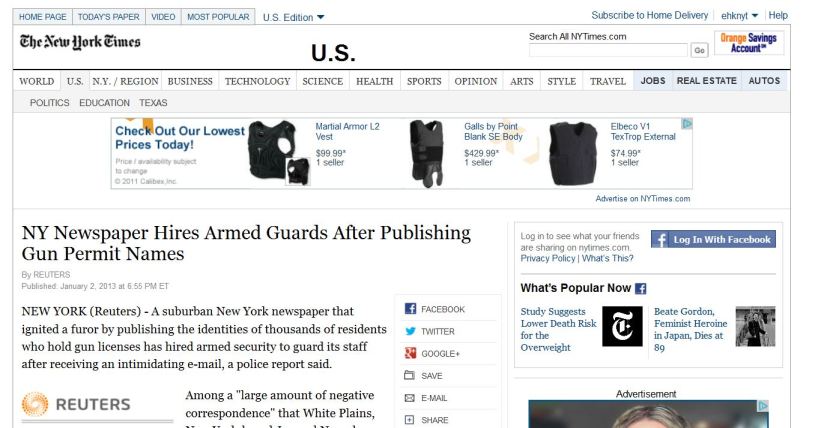
The Journal News hired armed guards after its staff was threatened for posting names and address of gun owners. The New York Times has some (automated) shopping advice to go with the armed guards. The wire story in the screengrab* isn’t showing up now and probably shouldn’t have been posted since it repeats a staff article from earlier today.

*Image courtesy of eagle-eyed Ed Kohn.

New York Post Made A Big Mistake; Mediaite, Others Made It Worse

The New York Post made a big mistake Sunday by publishing a Facebook chat “interview” with an imposter masquerading as the brother of Newtown shooter Adam Lanza. Mediaite made it worse, first hyping the report with zero skepticism, then keeping its story hyping the original NYP report up hours after the tabloid’s update with a family spokesman denying Ryan Lanza gave the interview or set up a tribute page for his brother and slain mother on Facebook.

The post was live hours after the New York Post updated its story with the spokesman's claim of a hoax.

The Mediaite version was live hours after the New York Post updated its story with the spokesman’s claim of a hoax.

When the site finally updated, it left a bad headline in place — only striking through Lanza’s name and adding a note at the top repeating the NYP statement. Someone apparently deleted an earlier tweet touting the initial Mediaite version — a tweet I did in reply is left but the original no longer shows up. Unlike the NYP, Mediaite didn’t tweet an update.

Mediaite's Lanza update

Mediaite wasn’t alone in running with a spurious story that never should have been published. Gawker replaced its post with a brief update but left up the comments about it — including those chiding it for believing the NYP at all. Yahoo News blew it by posting the story, then putting the “update” at the bottom. Gothamist did a write through with the update but the url still heralds the mistake of playing follow the leader with the Post. Huffington Post is the only one I’ve seen so far to run an editor’s note explaining the situation. No apology.

Admitting to a hoax without apologizing.

Admitting to a hoax without apologizing.

For all of its faults, starting with ignoring a field of red Facebook flags, when the Post was notified, the headline was changed and the update was tweeted. It would have been even better to run a formal correction and/or admission of error. Instead, the tabloid left a lot of the details for the Washington Post to fill in.

As for the lemmings that followed the NYP thinking that attribition to another media outlet offers some kind of pass or absolution in case a story is wrong, it doesn’t.

Gift That Keeps On Giving: Dropkick Murphys Live in the Lab

The Dropkick Murphys played a holiday set at the hometown Boston Globe Digital Lab in early December. I’d prefer the full concert but that may be a minority view. Instead, it’s a video playlist with individual songs, including the classic Irish Rover (embedded below).

This should have taken a couple of minutes to post. Instead, I learned a lot more about the limits of WordPress.com video and the vageries of the Brightcove player then I could have imagined. The solution I went with meant skipping the manual embed that would give me more control over the post, giving the player access to my WordPress account and publishing immediately, then going into the post to update. It’s also a dead-end video sans playlist. Oh, well, the results still rock.

Looking For Clarity In 2013? Not Gonna Happen

We live in a time of unprecedented access to entertainment, news, information — even to each other. But that access requires navigating a digital labyrinth, with toll booths, hidden doors, gates that only open in one direction, false exits, and misleading turns — along with some clear paths and dazzling topiary. I wish I could say that will get easier in 2013. It won’t. And if there’s one prediction I feel safe in making, clarity isn’t even in our mid-range future.

Why? I explain as part of the Nieman Jopurnalism Lab 2013 predictions project. (Thanks for including me, Josh.) Lots more on a variety of topics from much smarter people.

The Apple Version of Baby Jail

An unwillingness to upgrade to iOS 6 has landed me in Apple’s software baby jail – a virtual playpen where I can go only so far without permission or swearing allegiance to the iOS flag. I can’t upgrade iPhoto or certain other apps unless I upgrade to flawed iOS6.  Irksome but I can live with that until I’m ready to make the switch.  Worse, no matter how much I’ve invested in Apple devices — hint:  typing this on my third MacBook Air 11” about an issue discovered on iPad 3 while iPhone 4S on the table – or iTunes apps,  I can’t upgrade an app I’ve already paid for unless I accept the latest change in iTunes terms and conditions.  This is on top of producing a new iOS that double-dog dares you not to install it because, as is so often the case with Apple, improvements and breakage come in the same package.  (Before anyone jumps on me, I know Apple isn’t alone in breaking features but it leads the pack in making life without OS upgrades difficult. Try watching an Apple video without the latest version of Quicktime.)

It isn’t a new frustration but it’s a reminder of the kind of thinking that sent me to Microsoft and DOS from Apple IIC years ago.  Apple’s version of the walled garden is considerably broader than it was back then when I went over the wall because it blocked the kind of software development encouraged by Microsoft. But it’s still a control freak’s paradise that requires a series of “Mother, may I’s” or “Please, sir, may I have anothers?” Today I blend them – I’m using Windows 7 on this MacBook Air and our other household computers are PCs. Every time I think about diving in, say going Mac for my new desktop, I run into a reminder that life in the virtual playpen is meant to work best when you don’t challenge the limits.

If ‘It’s Not A Conversation,’ You’re Not Doing Your Job

This quote from Craig Silverman’s excellent exit interview with Arthur Brisbane explains so much. When the public editor of The New York Times chooses to believe that he is not in a conversation, you get the kind of remoteness and disconnect that marred Brisbane’s tenure. Even before social media, the best people in the role of ombudsman or public editor at any media outlet were the ones who mixed engagement with expertise and explanation.

I preferred the paradigm that says there’s an article, there’s a complaint, and there’s a point of view that I’m going to arrive at and express, and that is the process. … It’s not a conversation. I can fully appreciate that one might say it is a conversation, and it goes on and on and on. That’s fine if somebody wants to take that approach. It’s not the approach I took.

Note: a little WordPress confusion led to a delay in publishing.