Journalist Fakher Haider Murdered in Iraq

How many of us risk our lives to cover the news? Some our colleagues covering Hurricance Katrina have been in harm’s way but few of us face the day in, day out danger confronted by reporters in war zones. Today’s news is the latest in a sad series: Fakher Haider, 38, husband, father of three and an Iraqi journalist and photographer working for the New York Times, was abducted at gunpoint and found dead hours later, hands bound, bag over his head.

More On Gabe Rivera’s Memeorandum

Britt Blaser wonders "Could someone ask them to light up katrina.memeorandum?" I approached Gabe about doing just that nearly two weeks ago. We went back and forth about the idea; his chief concern was  whether a hurried effort would add enough to the conversation about Katrina. (via Scripting News) It took Gabe months to get tech.meme to beta and then live; it may all be automated but getting it that way required an intense amount of work on his part. Ideally — from my perspective — he’d be able to set up something in response to breaking news but it might require a different approach to sourcing. Now that tech.mem is live maybe the idea of a dedicated Katrina page can be revisited.

One other point: As good as tech.meme and its predecessor are, they aren’t exhaustive. In order to be included in the conversation, the site either must be part of the primary list or, I believe,  linked to by someone in that universe. 

Gabe, if I’m off target, I feel confidant that you will set me straight.

Related: Automated Tech News Site Goes Live

Automated Tech News Site Goes Live

A nifty new web service went live tonight — Gabe Rivera’s tech.memeorandum.com. I’ve been testing Gabe’s handiwork since late June when he sent me a note suggesting "you might be interested in monitoring my still-in-development Tech news site.  By "interested", I mean it actually might assist you in your work!"

He was right. I quickly became addicted to checking the site, often multiple times a day, to see what kind of buzz it was picking up in the tech world. The pages are built automatically, pulling from mentions across the tech blogosphere and news universe. Just posting may not be enough to make the page, as I quickly found out, but posts bubble up as links multiply. One link from a site weighted heavily in Gabe’s equation can push a post into view.

Gabe explains his goals here so I won’t go into detail. The highlights: Recognize the web as an editor;  rapidly uncover new sources; relate the conversation. I like watching the conversation evolve as a story moves around the web, often in ways I would not have imagined.

He started the process with a politics/current events page that crosses political boundaries and cuts through some of the partisan kludge. I’ve given him a couple of ideas for future memeorandums — personally, I’d like one on journalism ethics — but these aren’t easy to build. I’m looking forward to whatever he puts his energy to next. Thanks for the head start on this one, Gabe.

Update: Just saw Robert Scoble’s rave review. He goes into enough detail for both of us.

Coda: That’s Gabe on the left — a picture he thought he wound up in by accident but I took very deliberately at the end of BlogNashville.
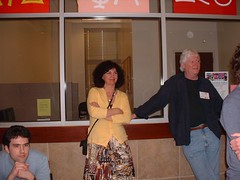
BlogNashville: Closing Session

Hurricane Katrina: USPS @ Work

Please share this.

The USPS efforts in the wake of Katrina sounded pretty impressive during a CNN interview with Postmaster General John Potter so I went to the web site for more information.  They’re making a great effort but the site information is barely penetrable. Next step: a phone call (not as easy as it sounds) to the media office; I heard back from someone within the hour — and I was glad I made the effort. Some key points:

  • People are sending money and other materials to the Astrodome and other shelters addressed to "any survivor." USPS spokesman Bob Anderson said that is causing more problems, in part, because some organizations won’t accept it; also, I gather, because it adds volume. Instead, the USPS asks that donors give cash to the relief agencies,  organizations, their religious institution — anywhere but through the mail to unknown recipients.
  • Different shelters have different mail procedures. For instance, Mr. Potter mentioned giving people at the Astrodome individual  P.O. boxes. That’s not the case for all evacuees or even for everyone there.
  • If you are trying to reach someone via mail the best bet is to send it to their old address unless they have given you a specific new one.
  • Survivors should make change of address requests ASAP even if they are only going to be somewhere for a few days. (The shelters should be able to provide the right address.) Electronic requests have the fastest turnaround — 24 hours and can be done for someone if they can’t reach a computer. Phone calls should be nearly as fast: 1-800-ASK-USPS (1-800-275-8777. The slightly slower standby: go to the nearest post office and fill out a form. The spokesman told me the rerouting starts as soon as the request is processed so anyone filing today could start to get mail in the next few days.
  • The web site may be misleading to some in one important respect. Some forms of mail are not being accepted for delivery to certain zip codes but I have been assured that doesn’t apply to first-class mail.

I urged him to ask for a more accessible explanation online both for survivors and for those trying to reach them. He said he would try. BTW, I made it clear when I left the message that I was not calling for an established media outlet but for information to share online.

Hurricane Katrina: Tagging Continued

For anyone who doesn’t know how to tag or is still uncomfortable with it, Alexandra Samuel has written a tutorial for Katrina tags. She offers examples that can be used as templates and explains how you can use a service like del.icio.us to tag other people’s posts. Please make use of it and share it. Alex also has set it up as a wiki because she hopes "others will edit and improve."

Many thanks to Nancy White for suggesting Alex as a resource — and to her and everyone else who continued the conversation on Katrina tagging.

Hurricane Katrina: Yahoo Missing Person Search Across Sites

Yahoo now has a Katrina missing-person search engine that draws results from multiple sites including its own message boards,  ICRC, Craigslist, Gulf Coast News, NOLA.com, Public People Locator, MSNBC, Refugee Connect, Hurricane Help, Castpost Missing Persons, Operation Get-InTouch and CNN.

I knew this was in the works but wasn’t sure when it actually would be usable. A big thank you to the people at Yahoo who gave up their holiday to make it work. 

Yahoo: Search Katrina lists from across the Web

The Blame Game

I agree with Rex that rescue and survival are far more important than blame.

Rex: We’re all outraged. We’re all in shock and disbelief. We all want to blame someone. But can we at least have a national day of mourning before we commence with this national day of blaming.

Here’s my suggestion: Keep writing all your evidence-of-responsibility
posts but hold onto them for a few days. Use those days to help people
find loved ones and to figure out what you can do to help. Raise money
for relief causes. Figure out how your church or civic club or
neighborhood can re-settle an evacuee family. Then, after a week or so
(September 12th at the earliest) go ahead and start back flooding the
blogosphere with blame.)

Unfortunately, the longer it takes to figure out who did — or, more to the
point, didn’t — do what, the easier it seems to be to shift the blame. Why
does blame matter? It’s not as if anyone in charge is going to be charged or as
if it can change anything that happened in the past week. But it can — and
should — help us understand how not to let it happen again.

I hope that anyone collecting facts about the events leading up to Katrina and the subsequent chaos continues to do so. The invective, the politics, the anonymous fingerpointing — that can wait.

Hurricane Katrina: (Not) Learning From The Tsunami

Evelyn Rodriguez lived through the Dec. 26 tsunami and understands communication and info needs from the survivor side. Most of what we are doing now is essentially for family and friends. Tens of thousands of survivors have no online access although efforts are underway to provide it as widely as possible.

In an emergency, think: Cheap. Simple. Ubiquitous. 
Perhaps cellphone SMS messages that go directly to a central
wiki that is hosted by an large
easy-to-remember-even-if-I-never-imagined-I-would-be-in-a-major-disaster
organization whether it is Red Cross or Google?

What would have been helpful in the tsunami was a central phone
number everyone has memorized to call in case of emergencies. I don’t
know if they have 911 in other countries. After the tsunami, people
(those on boats, and high ground) still had cellphones. But no one knew
who to call.

These were lessons that should have been learned from the tsunami and before that from 9/11 and other times of crisis. We can’t change the events of the last week but if we do not learn from them and change the future, shame on us.

Hurricane Katrina: Tagging

Efforts are underway to harness the vast amount of information being generated about Hurricane Katrina. If you are hosting sites providing critical information, please tag according to your purpose so your site and posts can be identified — katrina and missing, safe, searching,  housing, survivor, food, jobs, volunteer, donate, collect, links, photos, reference, etc. If you see sites that aren’t using tags, please encourage it — not everyone knows what tags are or how to use them — and/or link to them with the appropiate tags via sites like del.icio.us , furl , MyWeb2.0 Some blogging software converts categories to tags.

Hurricane Katrina: Link Blog

FYI, in addition to the links at the OJR Wiki, I’m keeping a running list of more diverse Hurricane Katrina links (in addition to the usual collection) at my OPML link blog. Some recent links:

  • Missing person/survivor sites’ listed
    at Yahoo: Thanks to Elizabeth Osder, I now have this. If anyone knows of any other sites collecting such information — formally
    or informally — that aren’t on this list, please let me know.
  • FCC is coordinating communications tech aid. Details at Boing-Boing.
  • This list at the central federal Hurricane Katrina site
    illustrates the difficulty of matching people with the missing and of
    tracking the missing. There are about a dozen different sites
    collecting info mentioned here and I know there are many more where
    people are posting. For instance, the list doesn’t include Craigslist
    or many smaller blogs and sites.
  • The remarkable Interdictor asks that anyone linking to his blog use
    http://mgno.com instead. The web cam feed from 650 Poydras is being
    mirrored at http://old.mises.org:88/NO2